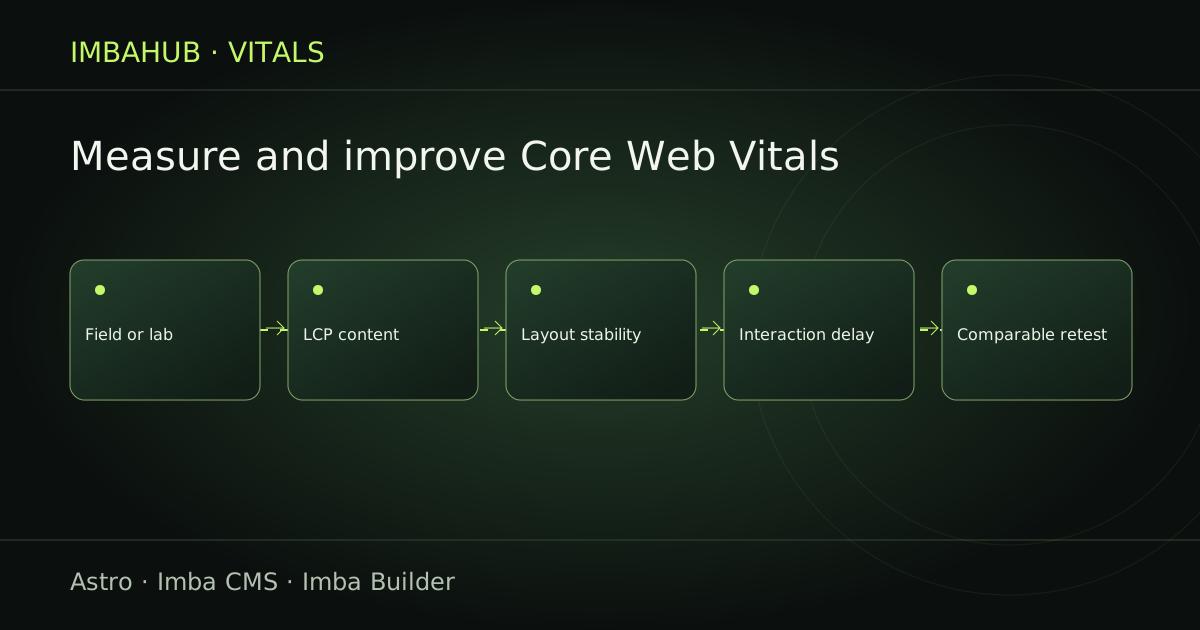
Begin with a representative customer journey
Choose pages people actually use: the home page, a service page and the route to enquiry. Test on a phone-sized viewport as well as a wider display. Note what the person is trying to do before interpreting the measurements.
A landing page that loads quickly but makes the offer difficult to understand still needs work. Performance is part of usability, not a substitute for clear content, accessible controls or a functioning contact route.
Understand what the measurements describe
Largest Contentful Paint concerns when the main visible content is rendered. Interaction to Next Paint concerns responsiveness to user interactions. Cumulative Layout Shift describes unexpected movement of visible content. They point to different classes of problem.
For example, an oversized hero image may delay prominent content; extensive JavaScript may compete with an interaction; and an image without reserved space may push a button down the page. Treat the measure as a clue and investigate the responsible resources or layout behaviour.
Keep laboratory and field evidence separate
A laboratory test is a controlled diagnostic run with a specific browser, viewport, network model and CPU conditions. It is useful for reproducing a problem and comparing a change under similar conditions.
Field data reflects visits from actual users and their varied circumstances. The two types of evidence can differ. State which you have, whether the sample is sufficient and what was changed between tests. Do not label a local Lighthouse score as proof of every visitor’s experience.
Fix the bottleneck without damaging the design
Start with the resources responsible for the delay or instability. Deliver appropriate image dimensions, reserve layout space, avoid lazy-loading the main above-the-fold image and load less important images when needed. Keep fonts and scripts proportionate to their job.
Review third-party tools before weakening the visual identity. A website may be carrying scripts unrelated to its essential tasks. Purposeful animation can remain when it does not block interaction, and reduced-motion preferences should still be respected. Changes should be compared visually and functionally, not accepted because one score increased.
Use a repeatable before-and-after record
Record the page, device model, test conditions, measured values and the actual implementation change. Recheck the enquiry flow, menus and image quality afterwards. A useful performance improvement preserves the functions people need.
- Check loading, responsiveness and layout stability separately.
- Keep comparison conditions consistent.
- Report unavailable field data as unavailable.
- Verify mobile navigation and form behaviour after optimisation.
- Connect technical findings to the customer task they affect.