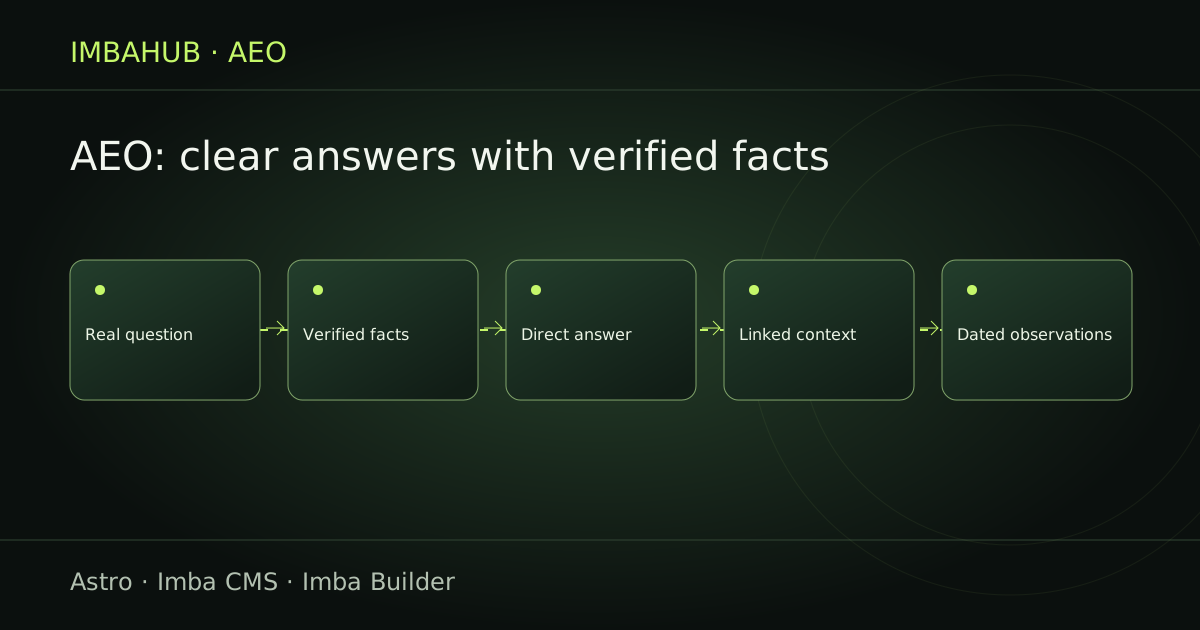
Describe the actual offer consistently
Start with a stranger’s questions: what does the business do, who is the service suitable for and what happens next? Put the answers on the relevant public pages. Keep organization details and the boundaries of the offer consistent across the site.
A claim such as “we improve websites” needs context. Explain whether the work concerns design, content, technical delivery, editing tools or marketing. Concrete limitations can improve the answer: a CMS screenshot does not establish that every workflow is included, and an advertising service does not buy organic recommendations.
Give each useful answer a visible home
Use a direct explanation near the main question, followed by the detail needed to make it reliable. Examples, comparisons and decision checklists can help readers understand where the advice applies.
Do not create a page for every minor wording variation. A good page can address related questions within one coherent subject. Repeated generic answers and city-name substitutions add little to either a human decision or an answer engine’s understanding.
Keep access and machine-readable information honest
Important explanations should be available as readable HTML with normal internal links. Organization, page and service markup should describe visible, verifiable facts. Do not invent offices, review scores or team members to make the structured data look more complete.
Search crawler controls and training crawler controls are different. Review the intended robots rules and the hosting security layer together. A bot allowed in robots.txt can still be blocked elsewhere. Optional machine-readable summaries may be useful for some consumers, but they are not an established guarantee of inclusion.
Use FAQs for people, not a discontinued display feature
A compact accordion can make specific questions available without overwhelming a commercial page. The answer must remain accessible to visitors and should expand on an actual uncertainty about that service.
Google has discontinued its FAQ rich-result feature. That does not make useful questions obsolete, but it removes a reason to promise a special result presentation. Schema, where used, should reflect the actual content rather than a hidden parallel version written only for machines.
Measure observations without turning them into promises
Keep a dated record of a citation or referred visit and the context in which it was observed. Answer engines vary their outputs, and one successful prompt is not a reliable measure of market-wide visibility.
Combine observations with ordinary search and business evidence: useful queries, accessible pages and relevant inquiries where tracking is configured. Prioritize corrections to weak information before producing a large volume of new AI-labeled pages.