Separate the visitor’s experience from the publishing process
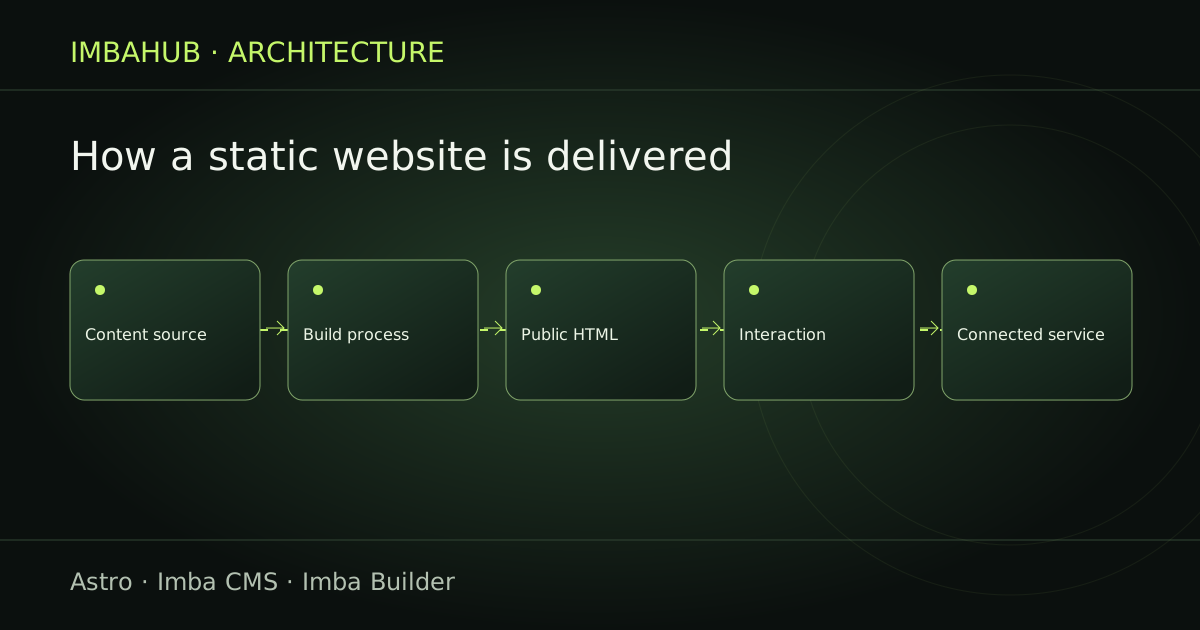
Imagine a small consultancy with service pages, team information and useful guides. Most visitors need the same public information. Preparing those pages ahead of a request can make delivery straightforward: hosting infrastructure serves the resulting HTML, styles, images and any necessary scripts.
The fact that the visitor receives prepared files says little about how an editor works. The team could edit source files, use a connected CMS or work through a visual interface. Those are authoring choices. The proposal needs to explain how a saved change becomes a published page and who maintains that process.
Where a CMS fits
A CMS stores and organises content and provides an interface for the people responsible for it. In a static setup, publishing may trigger generation or replacement of public assets. The editor should not have to understand that mechanism to perform an agreed routine update.
With ImbaHub, Imba CMS and Builder provide the relevant content and visual editing tools for the installation. A demonstration should include a real task: change a heading, replace an image, review the phone layout and publish through the intended workflow. It should also show where a developer’s help is still needed.
What static files do not solve by themselves
A contact form needs somewhere to send its data. A booking tool needs access to availability, and customer-specific information needs appropriate authentication and processing. Prepared pages can link to or call those services, but the services do not disappear.
List each live function before selecting the architecture. Establish its provider, access requirements, failure state and operating cost. A good static website can combine lightweight public content with carefully scoped dynamic functions; it should not pretend that every requirement has become a static file.
Benefits need operating conditions
Prepared delivery can reduce the number of public application components involved in an ordinary page request. It can also make page caching and distribution easier to reason about. Actual speed still depends on image weight, scripts, fonts, hosting and the page design.
Security remains a responsibility. Editorial accounts, dependencies, form endpoints, domain access and deployment permissions need protection. “Static” is not a promise that a website cannot be compromised, and no framework automatically gives the site higher search rankings.
Questions to take into a project discussion
Use the delivery model as one part of a practical decision. The right choice should support the content, the required live functions and the people who will maintain the website. Ask for explanations in terms of your own tasks rather than a list of framework features.
- Which information can our team edit without code?
- How do drafts, review and publication work?
- Which live services remain necessary, and who operates them?
- What assets do we own, and what depends on an ongoing service?
- How are failed publishing jobs or inquiry delivery problems detected?
- What would a future move to another provider involve?